

Spring Snow
Nieve de primavera

Equinoccio de primavera, al fin.
Mi cabello se seca al sol.
Mi sonrisa ⏤
Congelada por la nieve.
Spring Equinox, at last.
Warm sunshine dries my hair.
A smile on my face ⏤
Frozen by snow.
Durante este mes de noviembre de 2025, continué leyendo sobre cómo escribir un haikú y leí la traducción de Octavio Paz y Eikichi Hayashiya “Sendas de Oku” de Matsuo Basho1. Gracias a las didácticas explicaciones de Paz y Hayashiya aprendí, primero, que este libro es más bien un diario de viaje que contiene prosa y haikus que documentan el paso de Basho y su acompañante de viaje por las remotas tierras del norte de Japón. Al darme cuenta de esto, comprendí que el ejercicio de escribir en prosa y también en verso que propongo aquí en Pluma Afilada, Basho lo hizo hace centurias también y se convirtió en todo un género literario en Japón. Me hizo recordar también mis diarios de viaje cuando viví en Inglaterra.
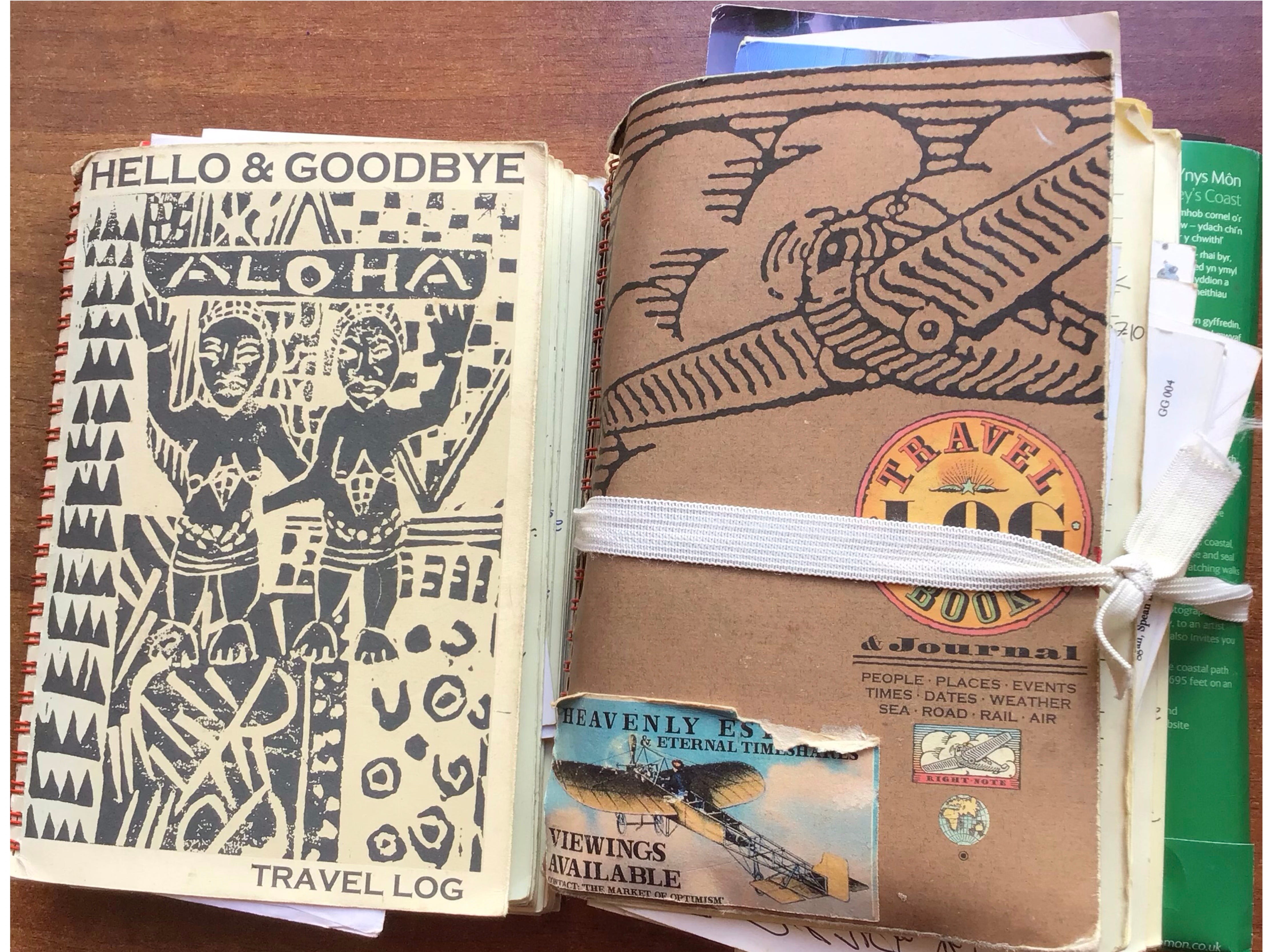
Aprovechando la energía de mercurio retrógrado del mes, decidí releer esos diarios de viaje. Y sentí un poco de remordimiento por no haber escrito más textos en verso para atrapar tantas cosas que vi en ese viaje. Luego de meditarlo un poco más, se me ocurrió que no era tarde para añadir los versos a todas mis entradas en esos diarios. Podría añadirles los haikus o minipoemas a eso que escribí hace 15 años, pensé. Para lograrlo, tuve que dejar de juzgar mis historias en esos diarios: dejar de decirme a mí misma, qué inmadura eras en este momento o puf! Caro, esto no era tan importante… tuve que dejar de latigar a esa Carolina joven por escribir lo que escribía y volver a sentir la emoción que me llevó a escribir eso que escribí en esos diarios.
En segundo lugar, gracias a Paz y Hayashiya también aprendí aspectos formales del haikú, sus temáticas y cómo evolucionó en Japón. Así que teniendo esto en cuenta, escogí una entrada de mi diario sobre el tema más trillado y común entre los británicos: el clima.
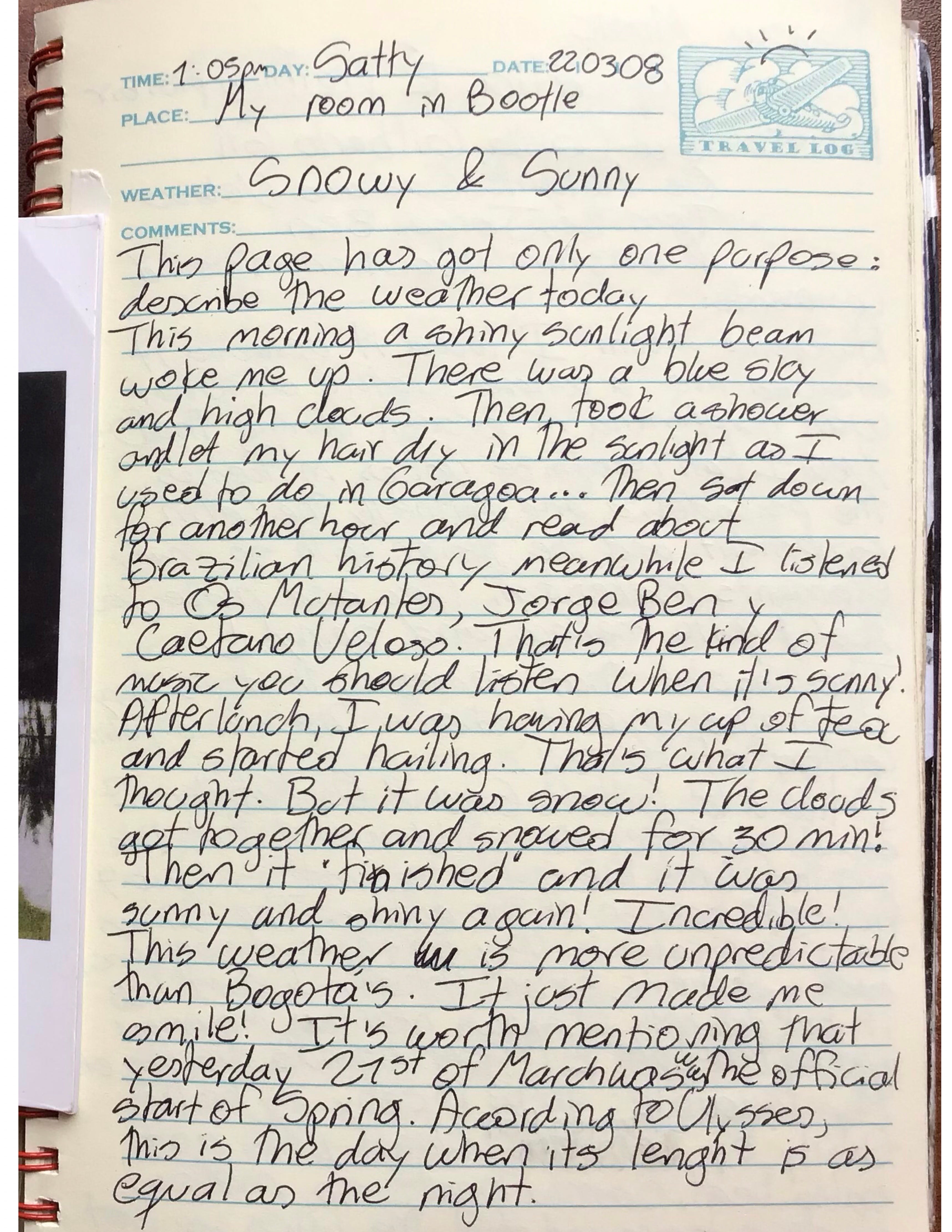
Y decidí añadirle un texto en verso que se acercara a mi propuesta métrica de Octubre o que al menos extractara un momento contemplativo de esa condición climática. Releí muchas veces esa entrada del diario tratando de recordar lo que había sentido al escribirla, leí las entradas de antes y después de esa fecha también para ubicarme en ese momento… releí hasta que logré recordar. Esto de escarbar en ese diario me tomó como tres semanas. Luego intenté garabatear alguna frase en inglés (como el diario estaba escrito en inglés, el primer borrador lo escribí/salió en inglés). Ninguna frase me gustaba: eran demasiado explicativas, narrativas, no atrapaban eso que sentí en ese momento. Rumié ese recuerdo durante varios días, estuve super inquieta y no me concentraba bien en mis otros quehaceres porque el borrador de este poema estaba pendiente y no se concretaba. No sabía por dónde agarrarlo. Seguí escribiendo frases en inglés en mi cuaderno. Desbaraté eso que escribí varias veces. Puse la frase que había escrito de último de primera, transcribí lo que se me ocurría, contaba las sílabas, y nada se ajustaba a mi propuesta métrica de Octubre y mucho menos a la métrica del haikú.
Hasta que leí otro fragmento del prólogo de Paz en el que explicaba que la primera parte de un haikú presentaba la condición general y la ubicación espacio-temporal del poema y la segunda parte presentaba lo inesperado y que la percepción poética surgía del choque entre ambas partes. Bueno, esto me sirvió para organizar las líneas versales de mi borrador y me pregunté ¿cuál es la condición climática general que quiero plasmar? Y ¿Qué es lo inesperado que quiero que choque con esa primera parte? Con estas dos preguntas releí no la entrada de mi diario sino los borradores del poema para encontrar estas dos partes. Y las encontré. Las transcribí y las releí muchas veces en voz alta. Me abstuve de jugar con algún tipo de rima y me aseguré de que cada línea versal recogiera elementos concretos sin “adornos”. Edité el texto lo más que pude hasta que lo reduje a lo mínimo. Volví a contar las sílabas. Y no me acerqué ni a mi propuesta métrica de octubre y mucho menos a la del haikú. Por tanto, desde un aspecto formal de métrica, este poema no es un haikú ni nada que se le parezca. Luego arreglé combinaciones de frases que no me sonaban mucho, lo reescribí varias veces hasta que sentí que si lo seguía editando, el pobre poema iba a desaparecer.
Finalmente lo transcribí a una postal y ahora esa entrada de mi diario se ve así:
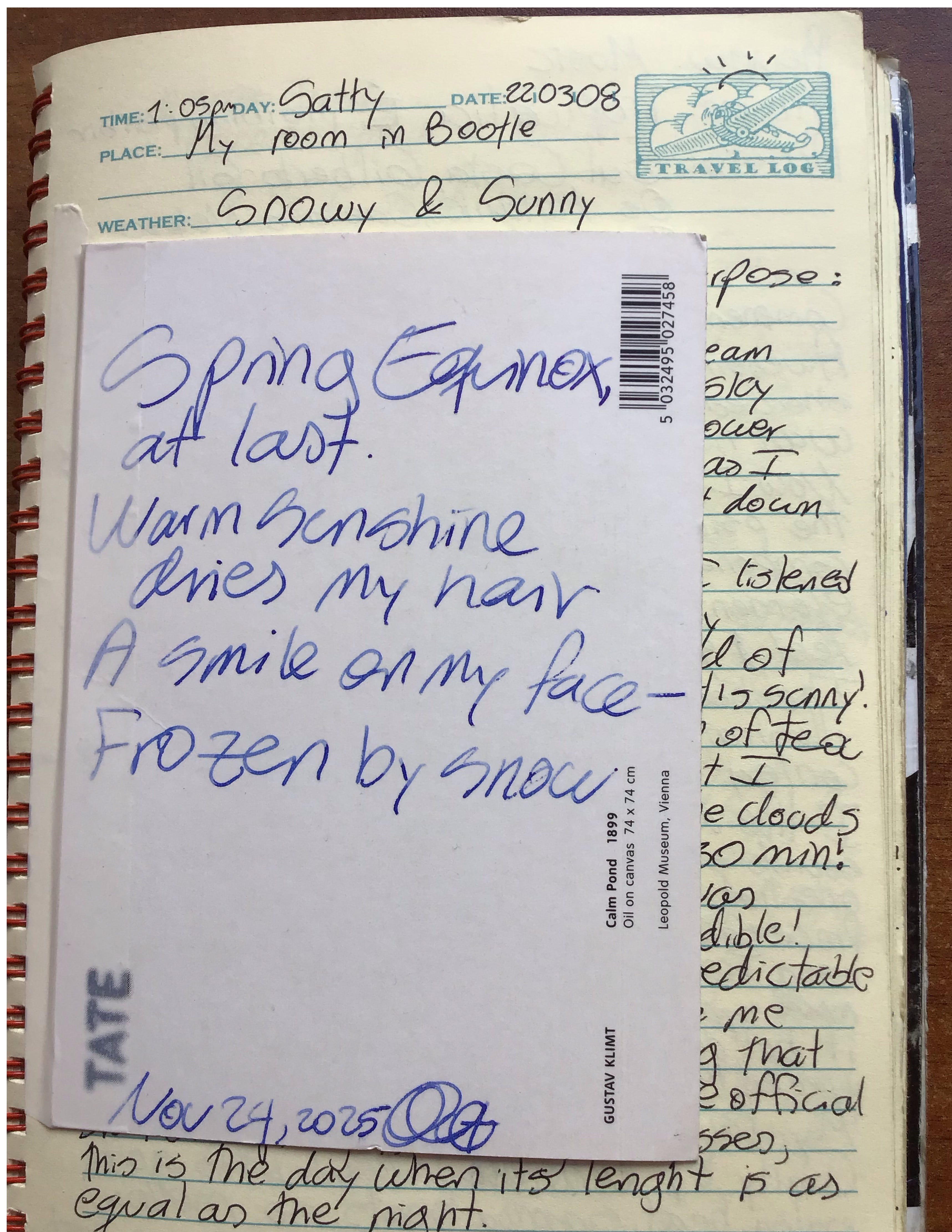
Escribir diarios de viaje acompañados de dibujos, poemas y prosa no es nuevo. Matsuo Basho lo hizo hace centurias. Aunque yo no dibujo ni tomo fotos (por eso compro postales que sí tienen fotos enfocadas y pensadas con alguna composición… la cual yo soy incapaz de lograr en el mismo momento que observo algo…necesito horas, años para lograr un buen encuadre), escribir diarios de viajes sí que me ayuda a conservar los recuerdos en orden. Escribir diarios de viajes me obliga a sacar tiempo para sentarme a escribir durante el mismo viaje. Y lo que escribo siempre me provee de buenos insumos para digerir todo lo que veo y vivo en un viaje. ¿Alguna vez han escrito un diario de viaje durante un viaje? Si es así, ¿Cómo lo hicieron?
Como siempre, muchas gracias por tomarse el tiempo de pausar, leer y dejarse tocar por las palabras: muchas gracias por completar mi proceso creativo con su lectura.
During November 2025, I continued reading about how to write a haiku and read the translation by Octavio Paz and Eikichi Hayashiya “Sendas de Oku” by Matsuo Basho. Thanks to the didactic explanations by Paz and Hayashiya, I learned first that this book is more a travel journal that contains prose and haikus that keep a record of Basho’s journey and his companion in the remote regions of Northern Japan. When realizing this, I understood that the exercise of writing in prose and verse that I do here on Pluma Afilada, Basho did it too centuries ago; and it became a whole literary genre in Japan. The book also reminded me of my own travel journals when I lived in England.
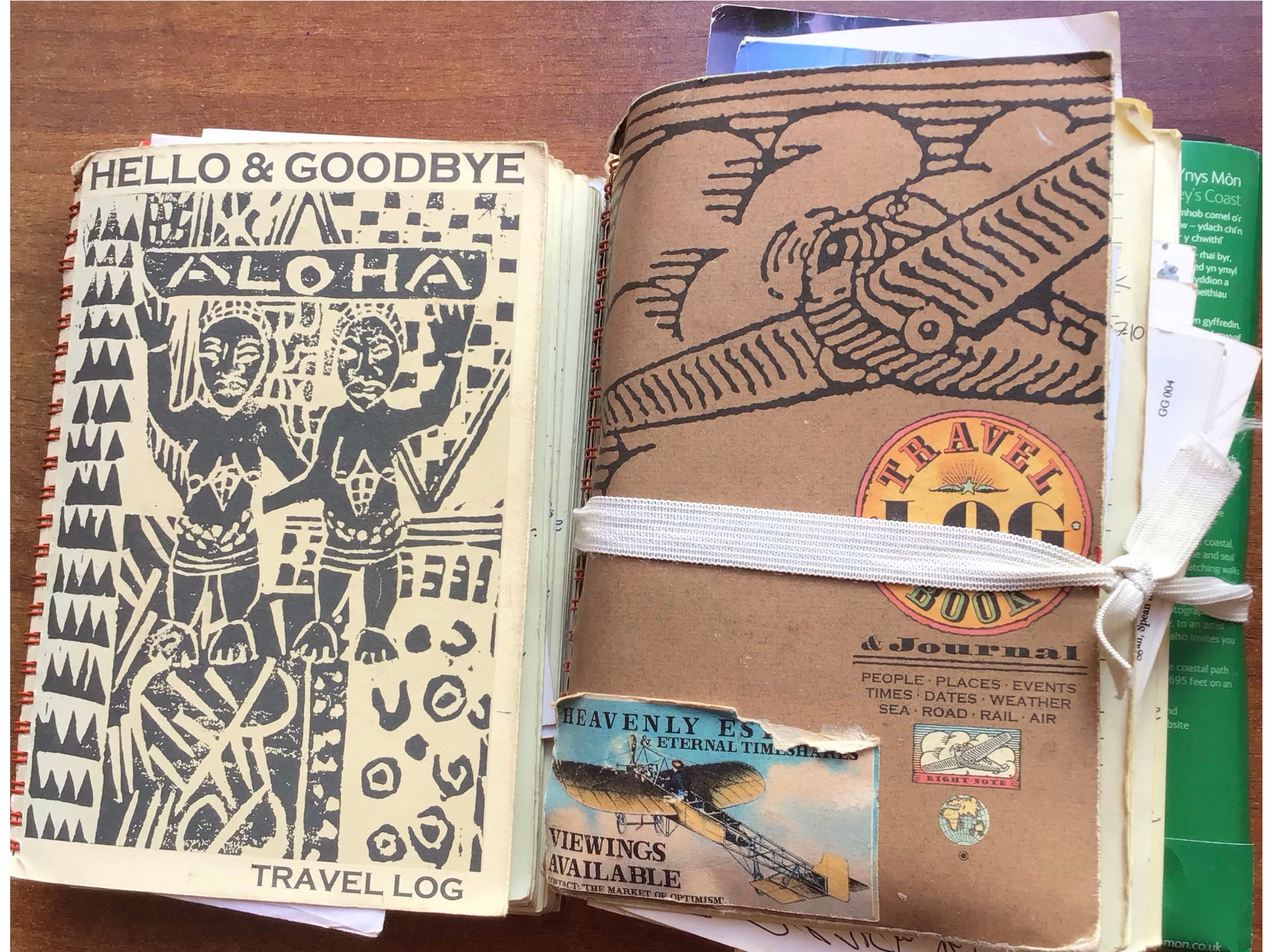
Taking advantage of Mercury retrograde’s energy, I decided to re-read those travel journals of mine. I regretted not to have written more verses to catch so many moments and emotions I felt during that journey. After meditating a bit more, it occurred to me that it was not late to add the poems to those travel journal entries. I could add haikus or mini poems to all what I wrote 15 years ago. To achieve it, I had to stop judging my own stories in those travel journal entries: stop telling me oh, how immature you were at that moment or pff! Caro, this wasn’t as important…I had to stop lashing that young Carolina for writing what she wrote, and feel again the emotion that led me to write what I wrote at that moment.
Secondly, thanks to Paz and Hayashiya I also learned formal aspects of haiku, its themes and how it evolved in Japan. So having that in mind, I chose a journal entry about the most hackneyed topic among the British: the weather.
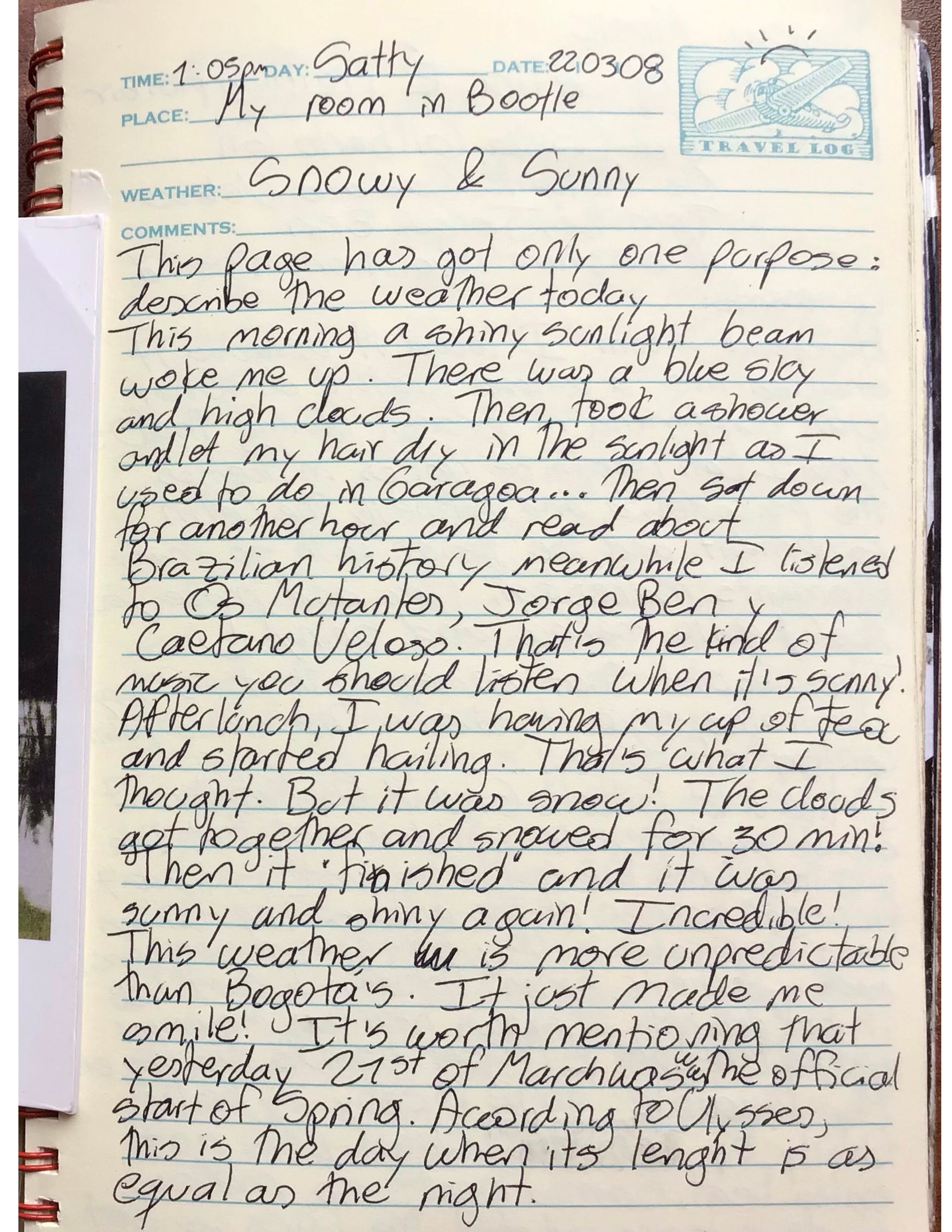
And I decided to add a text in verse close to my metrics proposal from my October Pluma Afilada, or at least, it extracted a contemplative moment from that weather condition. I re-read that journal entry trying to recall what I had felt when writing it. I read the journal entries before and after to locate myself at that moment. I re-read it many times until I remembered. It took me like three weeks. Then I tried to doodle a phrase in English (it came out in ENglish because the travel journal was written entirely in English). But I didn’t like any of those phrases: they were too explanatory, too narrative, they didn’t catch the emotion I felt at that moment. I ruminated about that memory for several days. I got restless and couldn’t concentrate well on my other daily chores because that draft was pending and didn’t get to settle on. I didn’t know how to write it or where to start. I continued writing phrases in my notebook. I unwrote the few phrases that sounded decent several times. I put first the phrase I had written last. I kept transcribing what came to mind. I counted syllables and none of the phrases got closer to my metrics proposal from October and even less, to the metric of a haiku.
Until I read another fragment of Paz’ prologue (see footnote) in which he explained that the first part of a haiku presented the general condition and the space-time location of the poem, and the second part presented the unexpected; the poetic perception emerged from the clash of the two parts. Well, this helped me organize the lines of my draft. Then I wondered: What is the general weather condition that I want to capture? And what’s the unexpected that I want to clash against? With these two questions in mind, I re-read not my travel journal entry but the drafts of the poem. And I found the answers to those two questions. I transcribed them and re-read them aloud. I refrained from playing with any type of rhyme and made sure each line gathered concrete elements without any “ornaments”. I edited the text until I reduced it to its minimum. I counted syllables again…but each line didn’t get even close to my october metrics proposal, and much less to a haiku. Therefore, from a formal aspect of metrics, the poem I’m sharing today is not a haiku or anything similar. Then, I arranged the combinations of words that didn’t sound very good. I re-wrote it several times until I felt that if I continued editing, the poor poem was going to disappear.
Finally I transcribed the poem to a postcard and now that journal entry looks like this:
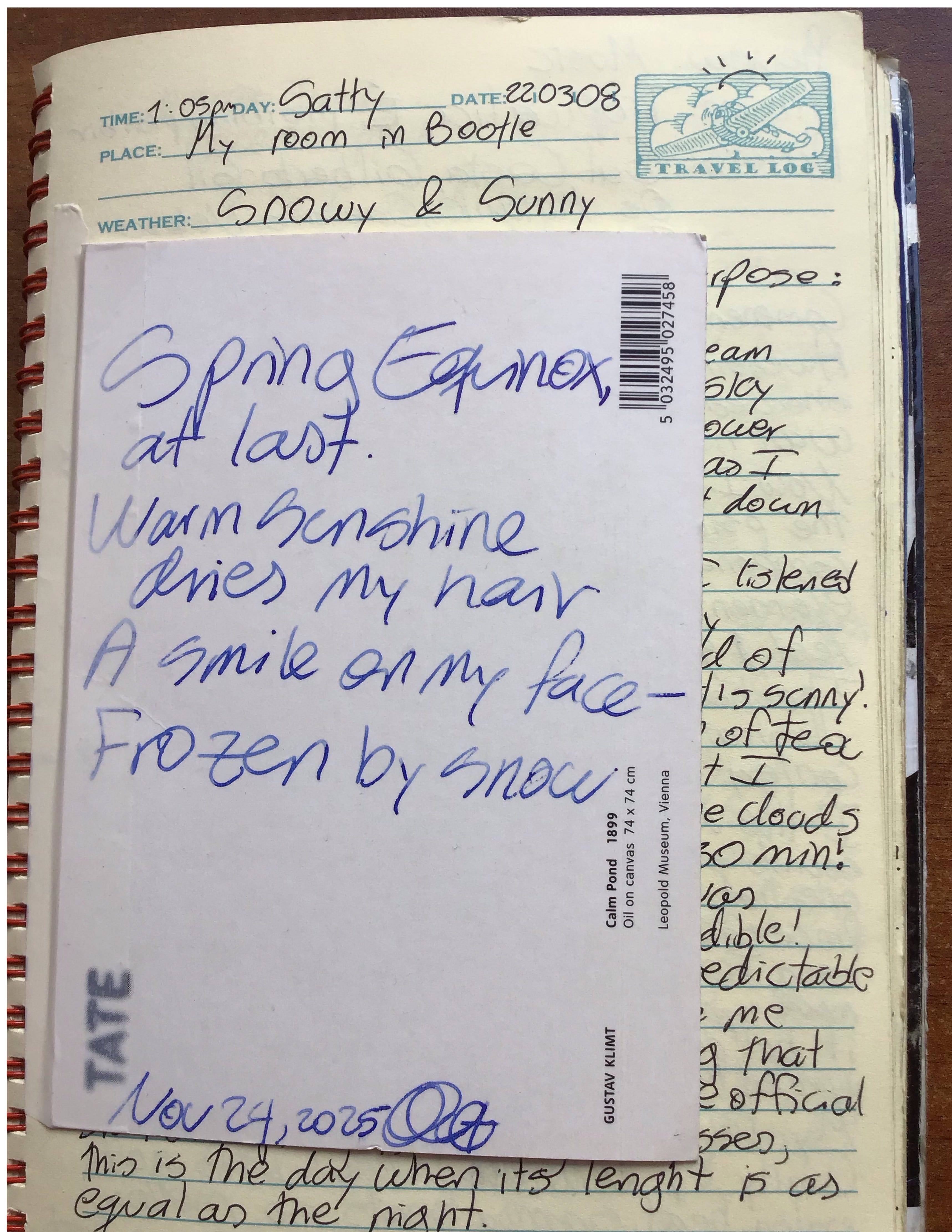
This experience of writing travel journals with drawings, poems and prose is not new. Matsuo Basho did it centuries ago. Although I don’t draw, nor I take photographs (that is why I buy postcards that do have focused photographs and have a good composition…which I would be unable to achieve in the same moment I observe something…I need hours, years to achieve some good framing), writing travel journals makes me allot the time to sit down and write during the journey. And what I write always provides me with good “supplies” to digest everything I see or experience during a trip. Have you ever written a travel journal? If so, how did you do it?
As always, thank you thank you for taking the time to pause, to read and let my words touch you: thanks for completing my creative process with your reading.
Matsuo, B., Taniguchi, B., Paz, O., & Hayashiya, E. (1992). Sendas de Oku: Texto japonés caligrafiado e ilustrado por Yosa Buson. Pontificia universidad católica del Perú.
Qué inspirador lo que cuentas. Releerse debería ser casi un ejercicio obligatorio: nuestra historia está viva y merece convertirse primero en prosa, y luego en un haiku escrito en el reverso de una postal.
Carolina. Desde que lo leí supe que era un haiku. Es una emoción concentrada, comprimida, densa, pura, noble y real que retrata un momento. Toda esa experiencia de recordar, releer, es necesaria. La disciplina de escribir tus vivencias es el mayor insumo. Y esa experiencia fue vivida y reseñada en tu diario para “congelar” ese instante en el tiempo y regalarnos este bello haiku. Y que no se destierre la costumbre de escribir diarios, un hábito que debe prolongarse en el tiempo, perpetuarse y transmitirse de generación en generación. Que mejor huella de nuestro paso por el mundo. Felicitaciones.